WELCOME TO OROMONET

The Home of Oromo Views & headline News from the Horn of Africa

Gabcast! Gotoota Oromo Haa Yaadannu. #17 - Wallee.


Thursday, November 24, 2011

Ethiopia: Stop Using Anti-Terror Law to Stifle Peaceful Dissent

Human Rights Watch (Nov. 21) The Ethiopian government should cease using its overly broad anti-terrorism law against journalists and peaceful political activists, Human Rights Watch and Amnesty International said today.

On November 23, 2011, the trial of 24 people charged with terrorism offenses on November 10 will continue. Those charged include six journalists and two members of the opposition Unity for Democracy and Justice (UDJ) party. Sixteen of the 24 are being tried in absentia. Several other terrorism trials of journalists and opposition activists are ongoing.

“The Ethiopian government is exploiting its vaguely worded anti-terror law to crush peaceful dissent,” said Rona Peligal, deputy Africa director at Human Rights Watch.

The Anti-Terrorism Proclamation of 2009 includes an overbroad and vague definition of terrorist acts and a definition of “encouragement of terrorism” that makes the publication of statements “likely to be understood as encouraging terrorist acts” punishable by 10 to 20 years in prison. These provisions mean that critics of government such as journalists and political opponents could be charged for encouraging terrorism, Human Rights Watch and Amnesty International said.

The organizations urged the Ethiopian government to facilitate systematic monitoring of the trials by the diplomatic community. The times and locations of hearings have been altered at the last minute at least twice during the ongoing trials. The government should ensure that key information, including location and time of hearings, is available to the public.

Amnesty International and Human Rights Watch also urged diplomats stationed in Ethiopia to carry out systematic monitoring of the ongoing terrorism trials and the trials of members of the Oromo political opposition arrested during 2011. This is particularly important in the absence of independent human rights organizations, which the Ethiopian government has effectively banned. While diplomatic representatives have attended several remand hearings and trial sessions of terrorism cases, none were apparently present at the November 10 confirmation of charges hearing, following a last-minute change of location, nor at the subsequent hearing on November 15.

Ethiopia’s foreign partners closely followed a series of trials from 2005 to 2007, in which treason charges were brought following contested elections. The Council of the European Union appointed a full-time trial observer, although the findings of its report were never made public. EU embassy staff monitored these trials on a rotating basis, and a US embassy staff member was also present.

“Diplomats’ systematic monitoring of these trials is essential,” said Michelle Kagari, deputy director for Africa at Amnesty International. “Without the presence of local civil society, diplomats can play a vital role in witnessing whether or not the suspects’ right to a fair trial is respected.”

None of the defendants detained and charged under the Anti-Terrorism Proclamation during 2011 had access to a lawyer during the pre-trial period. Three of those charged have complained in court of mistreatment in detention.

Public comments by Prime Minister Meles Zenawi and the government spokesman, Shimeles Kemal, have undermined the defendants’ presumption of innocence, Human Rights Watch and Amnesty International said. Their comments might also exert political pressure on the courts in a country where the judiciary lacks independence.

Since June 2011, the Ethiopian government has charged at least 33 people under the Anti-Terrorism Proclamation of 2009.

In addition, in 2011, at least 98 members of the two main Oromo political opposition parties, the Oromo Federal Democratic Movement (OFDM) and the Oromo People’s Congress (OPC), have been arrested and charged under the Criminal Code on the basis of alleged involvement with the Oromo Liberation Front, a banned rebel group.

Seven of the people charged on November 10 had previously been charged during the trials that followed the 2005 elections. All had been given presidential pardon. Three of the seven are among the defendants who are now in custody, two others fled the country after their earlier release, and two were already living in exile when they were charged in the earlier cases.

Human Rights Watch and Amnesty International have long called for the anti-terrorism law to be amended to bring it into line with Ethiopia’s domestic and international legal obligations.

“The anti-terror law itself is a huge problem,” Peligal said. “The international community, especially the European Union, United States, and United Kingdom, should ask the Ethiopian government hard questions about why it is using this law to crack down on peaceful independent voices.”

Sunday, November 13, 2011

Landgrabbing in Ethiopia: Legal Lease or Stolen Soil?

By Philipp Hedemann* | November 13, 2011

ABABA, Nov 12, 2011 (IPS/Street News Service) - Kneeling in the middle of a sugar cane field in blistering 40 degree heat, a young boy is digging up weeds while an Indian worker stands over him to make sure he does not miss any. Red is eight years old and earns 73 pence for one day’s work - less than the cost of using pesticides.

By exporting food produced by child labour in Ethiopia, an Indian farm manager hopes to earn millions within three years. "It's still total wilderness here, but we will soon start growing sugar cane and palm oil and everything will look tidy," explains Karmjeet Singh Sekhon as he drives in a Toyota 4x4 through the burning bushland on his farm.

The 68-year-old Indian is the manager of a huge farm, which covers an area of 100,000 hectares in Western Ethiopia. Soon he wants to farm 300,000 hectares, an area bigger than Luxembourg.

Since 2008 there has been an unprecedented rush to secure farmland in Africa, South America and Asia. This is a result of the rise and fluctuation in food prices on world markets, which has seen food riots in a number of countries. Countries such as India, China and the Gulf states want to feed their growing populations, but are also looking to position themselves in the race to produce bio-fuels.

The World Bank says 45 million hectares of farmland were leased in 2009 - up from only four million a year between 2006 and 2008. It is estimated that by 2030 another six million hectares will be leased annually in developing countries, two-thirds in sub-Saharan Africa and South America.

Maize, rice, wheat, soy, sorghum, sesame, sugar cane and oil seeds are the main commodities. The World Bank sees both opportunities and risks.

"These large land acquisitions can come at a high cost. The veil of secrecy that often surrounds these land deals must be lifted so poor people don't ultimately pay the heavy price of losing their land," said former World Bank managing director Ngozi Okonjo-Iweala.

In the world's thirteenth poorest country, the race for the country's most productive agricultural land has only just begun and the social and environmental consequences are unforeseeable. According to the U.N., 4.5 million people in Ethiopia are currently in need of aid as a result of a devastating drought. The majority of the food aid is imported from abroad.

"No problem," says farm manager Sekhon. "Some parts of our production remain in the country, and through the export Ethiopia gains hard currency to buy at the world market."

There is no law in Ethiopia to ensure that a certain percentage remains in the country. Karuturi marketing and logistics boss Birinder Singh makes no secret of the fact that his company is commercially orientated. They will sell to those who pay most, whoever that may be.

Eighty-five per cent of Ethiopia's population of 80 million live off the land, and little has changed over the past 100 years: most of the tiny fields are still worked using ox-drawn ploughs and the yields are low.

The government hopes that leasing farmland to foreign investors will lead to a wave of modernisation. According to the Food and Agricultural Organisation, food production needs a 70 per cent boost between 2010 and 2050 to meet global needs.

All Ethiopian land – 111.5 million hectares - belongs to the state. According to the government, three-quarters of it are suitable for agriculture, but so far only 15 million hectares are cultivated.

The government has now assigned 3.6 million hectares to foreign and domestic investors. One hectare of land costs between six and 231 dollars a year to rent, and the contract periods are between 20 and 45 years. Critics say the developing world is being sold off.

But Ethiopian Prime Minister Meles Zenawi rejects the attacks as "ill-informed" or even "ill-intentioned." "We want to develop our land to feed ourselves rather than admire the beauty of fallow fields while we starve," Zenawi said.

It is not surprising that the Ethiopian government has become the darling of international agribusiness investors. "There is plenty of good land, enough water, a cheap labour force, and a stable government that ensures law and order", says Karuturi's Singh.

According to Esayas Kebede, head of the state agency which is responsible for the land leases, Ethiopia benefits in many ways from the deals. "By exporting food, we will receive dollars, the farms provide jobs, they import know how, they will help us to boost productivity and therefore to improve food security," says Kebede.

But many local farmers are not convinced. Ojwato is one of them. It only takes him a few minutes to cross his two acre field on foot, while Sekhon takes several hours to cover his by jeep.

The idea that his neighbour's harvests are being exported while he and his country regularly receive food aid makes Ojwato angry. "The foreigners promised to bring electricity, water and hospitals. But in the end only a few of us have worked in their fields and the pay was poor," the farmer says.

"We always pay the national minimum wage," Singh claims.

"Nobody is forced to work on the farm," Kebede says. However, many children labour on the fields.

Though his family could use some extra money from child labour, Ojwato forbids his children to work on the Indian farm. One day they shall become doctors, teachers or engineers, he says. But therefore they need to go to school, instead of working on the fields.

Not all parents are as far-sighted as Ojwato: "Sometimes only five out of 60 students are attending class. The others are working at the fields," says Tigaba Tekle, deputy headmaster of a school near the Karuturi farm.

Officially, only uninhabited land is used for the giant farms, but human rights groups fear that people are forced to leave their land. As a matter of fact, a state-run relocation programme is currently taking place in Western Ethiopia.

According to the government, there is no link between the relocation and the farm projects; everybody moves voluntarily. Human right groups doubt this, and the author was obstructed several times during the research for this article. The official reason given was: "We don't want you to gather politically unwanted information."

As well as human rights organisations, environmentalists also have a problem with the farms. Some four decades ago, 40 per cent of Ethiopia was covered by forest, but today it is less than three per cent - and the bushland in Gambella is burning.

Farm manager Sekhon does not hide his lack of interest in environmental concerns. For him, it is important to develop the farm, and he is behind his ambitious schedule. To catch up, little Red and his friends must continue weeding.

* Published under an agreement with Street News Service.

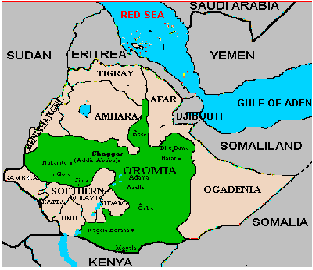
Map of oromia

Map of oromia