Moscow makes record arms sale to Third World
Moscow makes record arms sale to Third World countries: Ethiopia one of Russia’s biggest customers
By Kester Kenn Klomegah
October 6, 2006 (MOSCOW) - Russia is increasingly supplying military arms and weaponry to developing countries in what defense analysts describe as the largest post-Soviet export deals.By striking its largest arms deal under military-technical cooperation with Asian, African and Latin American countries and agreeing to write off some Soviet-era debts, Russia is also testing the ground for sales to other solvent and arms-hungry debtors, Russian defense analysts say.This has become important because Rosoboron export, the state agency whose sole responsibility it is to handle all transactions, hopes to offer competitive projects both for delivery of new armaments and for restoration, overhauling and updating armaments and military equipment that it delivers to its Asian and African partners, Rosoboron export spokesman Aleksander Uzhanov told IPS.The expected increase in the export of military goods is significantly due to changes in foreign and defense policy with the countries involved that have shown readiness to forge cooperation in this sphere with our country, he said.The Russian sales seek also to strengthen its position in the global arms military technological market, especially under competitive conditions that have appeared in this activity after the end of the cold war Uzhanov said.The objectives of Rosoboron export include signing contracts for the sale of Russian weapons and military hardware abroad, and supporting projects that bolster prospects for the future.A significant rise in revenues from exports is expected by the end of the year for the first time after the collapse of the Soviet empire, Uzhanov added, without giving concrete figures. An authoritative source told IPS that Rosoboron export has a new portfolio of orders exceeding $17 billion this year alone.Among the African nations, Algeria, Ethiopia and South Africa have had the largest military deals with Russia. These deals have delivered large numbers of Russian air defense systems, fighters, small arms and ships this year.Contracts have been signed for the delivery of Russian arms and military equipment to Iran with a total value of more than $1 billion. India has imported $9 billion worth of weapons and military hardware since 1998, a source in the Russian defense industry told IPS.The overall arms export is undergoing some strategic changes, Ruslan Pukhov, head of the Centre for Analysis of Strategies and Technologies, a Moscow-based defense think-tank, told IPS.Russia, he said, aims at scaling down considerably the political influence of its rivals such as the United States, Britain and France.Pukhov said that in the weaponry market today, aircraft account for half the arms trade, ships 25 per cent, air defence weapons 15 per cent, and weapons for the army the rest.Uzhanov said African states are now showing greater interest in Russia's arms, while India and China remain strategic partners. Russia continues to maintain its markets in Malaysia, Indonesia and Vietnam, and is seeking a breakthrough in Latin American states as it recently did with Venezuela.Venezuelan President Hugo Chavez has described cooperation between his country and Russia as long-term and comprehensive. Russia and Venezuela have signed arms contracts worth more than $3 billion.Commenting on a US announcement that the purchase of Russian arms exceeds Venezuela defense requirements, Chavez said: This announcement is part of the absurd claim of the US to the role of world master. Who said that the US. has the right to decide on a defense concept for Venezuela? Only Venezuela itself has this right. We are getting rid of the American empire. Russian President Vladimir Putin is pushing arms sales strongly. Intense competition on the global weapons market requires Russia to permanently adjust its government policy in military-technical cooperation with other countries, Putin said at a meeting of the Commission for Military-Technical Cooperation.In terms of its significance and scope, the global weapons market is comparable with such segments of the global economy as energy and food, he said. Competition here is extremely strong. It is too early to speak about an end to the arms race, Putin said. In fact, it is unfolding. It is essential to advance modern forms of cooperation steadily. Dawn/ The IPS News Servicehttp://www.dawn.com/2006/10/06/int11.htm
Sunday, October 08, 2006


Friday, October 06, 2006
The political dimension to the deadly floodwaters in Dire Dawa's Dechatu River
Foreigners or strangers who know Ethiopia as a country chronically struck by drought and often its problems qualified and known to them in a denigrating phrase “Ethiopia’s food aid addiction” rather than “floodwaters”, the story of Dachatu river of Dire Dawa that has currently overflown its banks causing hundreds of deaths and thousands of displacements, should surely be received by a surprise. We have seen the world wrestling with enormous natural calamities such as Tsunami, and different forms of hurricanes along the coasts of the United States of America. Indeed, in the eyes of these major unpredictable and uncontrollable calamities, the floodwater that bursts out of the riverbanks and claims lives and demolishes property in Ethiopia is insignificant and even incomparable. Except for Tsunami the deaths caused by different forms of hurricanes were minimised by relentless rescue efforts. Of course, Ethiopia is too poor to compare to U.S.A in terms of rescue efforts and capabilities. But still the disasters caused by a small local river is much more stunning, worrying. At least about 500 people were killed by the incidence of Dachatu river over a night, unknown number of them were trailed down the course of the river, and about 15,000 more shack dwellers have been left homeless. Within Africa itself, Mozambique a country that usually faces flood disasters, the rescue efforts and campaigns have been very impressive in terms of keeping death tolls lower. In India also floodwater rescue effort minimises deaths to a level much lesser than Ethiopia’s.
Unlike other natural disasters that are unpredictable like hurricane, or earthquake, the overflow of Dachatu and Awash rivers take place only during the rainy season once a year for about two months maximum. In spite of this, the Ethiopian government, both the federal and the regional, knows from past trends that the rivers Awash and Dachatu overflow because of their narrow banks. But it has never used these trends as a forewarning for preventing or minimising the cyclical disasters that hit every year July to September. What the central and the local EPRDF/TPLF governments have rather done from 2003 on is to follow a policy of resettlement and expanding of city residences along the banks of the mentioned rivers. The TPLF/EPRDF name such a scheme “City Development”. The people who live along these riverbanks are not really living decent lives. They are kinds of people who can be categorised as living in absolute poverty (lucky ones, earning less than $ 50 cents and others earning nothing). So, you might rightly expect the kinds of settlement to be of the type called shack or shantytown. Before the floods swept away everything, there were people who even used to live in tattered plastic tents hardly having their meals even once a week. The major problem is not, however, the type of settlement here.The core problem is that the Ethiopian government has done little or none to minimise or prevent the stunning figures of human loss this year or/and the previous years along the banks of Dachatu and Awash rivers. Basically, in times of such minor floodwaters, it is appropriate to see at least some rescue efforts to save lives in the sites. But this has never happened; no helicopter or boats were seen around rescuing engulfed people operating at both local and national government levels. No one who knows the reality on the ground disagrees with the legitimate accusation that TPLF/EPRDF does not care about the people in times of fatal emergencies caused by Dechatu and Awash river, inter alia. Three fundamental insidious policies and actions taken by TPLF/EPRDF in courses of such disasters against Oromo people and other oppressed Ethiopian people can be mentioned without any overstatement. Firstly, it has categorised residents of the areas under floodwater as supporters of Oromo Liberation Front, a veteran political organisation which struggles for the freedom and democracy of all peoples of Ethiopia in general and for Oromo in particular. Thus, as a manifest draconian act, the government is more than happy to see civilians which it calls “enemies” being washed away. Secondly, at both national and local government levels, the governments attention is very poor in lines of carrying out rescues during water caused or fire caused hazards.Its attention is focussed on crushing political opposition in all it forms and it spends billions of birr in that line. That is why there are less rescue boats, less trained rescue personnel and disaster fighters- immense lack of interest in exercising public safety of all sorts. Thirdly, it follows an uninformed policy of urban development and expansion of cities and towns. For instance, it would have been possible to dig and expand the narrow riverbanks of relatively smaller rivers such as Dachatu to prevent recurrent disasters. Or it could have done the resettlement and “urban development” away from the reaches of the river.This county is a landlocked country and most of its waters are streams or tributaries that can really be controlled at least at the level of rescuing lives. As such it has been the negligence and indifference of the EPRDF/TPLF regime that has been reflected in the deaths and displacement of innocent Dire Dawa residents. It is really one of the shames that our government lives with. We know other neighbouring countries in Eastern Africa have rivers and even bigger lakes like lake Victoria. But why does not floodwaters sweep away humans and houses there? What is unique about rivers in Oromia, Ethiopia? Thus, the international community and aid organisations must take critical view of what is happening in Oromia, Ethiopia before they just reach a conclusion that it is just another uncontrollable natural disaster striking Ethiopia like elsewhere. The EPRDF/TPLF is responsible for seeing the people vanish without attempts to rescue. The arrival of the Prime Minister after the event only shows a contempt and disrespect for people. Perhaps, what Meles contemplates is how he can use the deadly event to ask for more foreign aid to build his army. Kerranssoo Biyyaa
Unlike other natural disasters that are unpredictable like hurricane, or earthquake, the overflow of Dachatu and Awash rivers take place only during the rainy season once a year for about two months maximum. In spite of this, the Ethiopian government, both the federal and the regional, knows from past trends that the rivers Awash and Dachatu overflow because of their narrow banks. But it has never used these trends as a forewarning for preventing or minimising the cyclical disasters that hit every year July to September. What the central and the local EPRDF/TPLF governments have rather done from 2003 on is to follow a policy of resettlement and expanding of city residences along the banks of the mentioned rivers. The TPLF/EPRDF name such a scheme “City Development”. The people who live along these riverbanks are not really living decent lives. They are kinds of people who can be categorised as living in absolute poverty (lucky ones, earning less than $ 50 cents and others earning nothing). So, you might rightly expect the kinds of settlement to be of the type called shack or shantytown. Before the floods swept away everything, there were people who even used to live in tattered plastic tents hardly having their meals even once a week. The major problem is not, however, the type of settlement here.The core problem is that the Ethiopian government has done little or none to minimise or prevent the stunning figures of human loss this year or/and the previous years along the banks of Dachatu and Awash rivers. Basically, in times of such minor floodwaters, it is appropriate to see at least some rescue efforts to save lives in the sites. But this has never happened; no helicopter or boats were seen around rescuing engulfed people operating at both local and national government levels. No one who knows the reality on the ground disagrees with the legitimate accusation that TPLF/EPRDF does not care about the people in times of fatal emergencies caused by Dechatu and Awash river, inter alia. Three fundamental insidious policies and actions taken by TPLF/EPRDF in courses of such disasters against Oromo people and other oppressed Ethiopian people can be mentioned without any overstatement. Firstly, it has categorised residents of the areas under floodwater as supporters of Oromo Liberation Front, a veteran political organisation which struggles for the freedom and democracy of all peoples of Ethiopia in general and for Oromo in particular. Thus, as a manifest draconian act, the government is more than happy to see civilians which it calls “enemies” being washed away. Secondly, at both national and local government levels, the governments attention is very poor in lines of carrying out rescues during water caused or fire caused hazards.Its attention is focussed on crushing political opposition in all it forms and it spends billions of birr in that line. That is why there are less rescue boats, less trained rescue personnel and disaster fighters- immense lack of interest in exercising public safety of all sorts. Thirdly, it follows an uninformed policy of urban development and expansion of cities and towns. For instance, it would have been possible to dig and expand the narrow riverbanks of relatively smaller rivers such as Dachatu to prevent recurrent disasters. Or it could have done the resettlement and “urban development” away from the reaches of the river.This county is a landlocked country and most of its waters are streams or tributaries that can really be controlled at least at the level of rescuing lives. As such it has been the negligence and indifference of the EPRDF/TPLF regime that has been reflected in the deaths and displacement of innocent Dire Dawa residents. It is really one of the shames that our government lives with. We know other neighbouring countries in Eastern Africa have rivers and even bigger lakes like lake Victoria. But why does not floodwaters sweep away humans and houses there? What is unique about rivers in Oromia, Ethiopia? Thus, the international community and aid organisations must take critical view of what is happening in Oromia, Ethiopia before they just reach a conclusion that it is just another uncontrollable natural disaster striking Ethiopia like elsewhere. The EPRDF/TPLF is responsible for seeing the people vanish without attempts to rescue. The arrival of the Prime Minister after the event only shows a contempt and disrespect for people. Perhaps, what Meles contemplates is how he can use the deadly event to ask for more foreign aid to build his army. Kerranssoo Biyyaa
Subscribe to:
Posts (Atom)
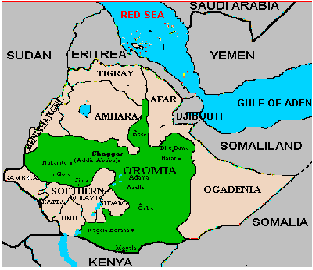
Map of oromia