WELCOME TO OROMONET

The Home of Oromo Views & headline News from the Horn of Africa

Gabcast! Gotoota Oromo Haa Yaadannu. #17 - Wallee.


Thursday, January 27, 2011

Sochii Ergamtoota Diinaa Kaaba Amerikaa fi Biyyoota Alaa Keessatti

Shira kan Hawaasa Oromoon Dhabama!!

“Barruun gabaabaa kun ergamtooti Wayyaanee sochii biyya alaatti taasisan qabatamaan muldhisa”

Mootummaan wayyaanee ummata Oromoo qabsoo mirga isaa kabajsiifatuuf gaggeessaa jiru irraa
gufachiisuudhaan bittaa sirna gabrummaa isaa hundee jabeeffatuuf yeroo adda addaatti shira xaxaa akka ture beekkamaa dha. Sirnichi QBO   ABOn durfamaa jiru dhabamsiisuuf tahuufii baannaan ammo laaffisuuf adda durummaan kan irratti fuuleffatu hawaasa Oromoo biyyoota ambaa keessa jiruu dha. Akeeka isaa farrummaa kana galiin gahatuudhaafis Ministeera Haajaa Alaa jalatti, Dhimmoota Diyaaspooraa kan jedhuun Damee utubuun maallaqa biyyattii miiliyoonaan itti dhangalaasaa ture; ammas itti jira. Ergama wayyaanee qabsoo Oromoo diiguun Oromoo fi Oromiyaa gabrummaa jalatti hambisuu akeekkate kana fudhatanii raawwataa kan turanii fi jiran ammo lukkeelee sirnichi ramadate
keessattuu OPDOta.

Murni bicuu TPLF ergama isaa kana wayta lukkeeleetti laatus akka hawaasa biyyoota alaa salphaatti
gowwoomsanii fi irraas deeggarsa argataniif jecha maqaa baazaarii misoomaa, ijaarsa bu’uraalee adda addaa fi tinnisa Waldaalee maqaa Oromiyaan dhaabbataniitin akka sossohan golgaa uuma. Kanaaf ammo dabaa-shirri sirnichi maqaa WMO jedhamuun biyyoota alaatti addatti USAtti gaggeessaa jiru akka fakkeenyaatti kaasuun ni danda’ama. Icitiin dhiyeenya kana keessa wayyaanotaatii nu dhaqqabes kan dabaa-shira sirnichi karaa lukkeelee isaa, maqaa Waldaa Misoomaa Oromiyaatin Kaaba-Ameerikaa keessatti hawaasa Oromoo keessatti gaggeessuuf jiru bal’inaan kan saaxile dha. Nutis Sagantaa har’aa keessatti akeeka ergama wayyaanee kanaan duuba jiruu fi namoota hoji-raawwachistummaan akeeka diinaa kana galiin gahuudhaaf sossohaa jiranii raga qabatamaa arganne
irratti hundaa’uun saaxilla.

Ragaan gola wayyaanotaatii nu dhaqqabe kun akka hubachiisutti, mootummaan wayyaanee QBO ABOn durfamu dura dhaabbachuu, diiguu fi dabrees madda galii isaa gogsuuf karaa dhaaba maxxannee isaa taate, OPDOtin, hojjetaa jira. Hojiin shiraa kun jaarmota Oromoo biroo kanneen sirnicha irratti qabsa’anis ni ilaallata. Sirnichi garaaf bultootaa fi lukkeelee ergama diinaa fudhatuun lammii isaaniitti umrii gabrummaa dheeressuu filatan bakka bakkaa walitti qabuudhaan golgaa Waldaa Misooma Oromiyaa-Kaaba Ameerikaa (ODA-NA) jedhuun ergama isaa itti laatee jira. Haaluma
kanaan gareen ergamtoota maallaqa guddaa wayyaanee irraa fudhachuun hojii shiraaf bobbaafamanii maqaanii fi hojiin isaanii kana gaditti ibsamu kunneen akka waan Waldaan ijaaramanii misoomaaf sossohanii fakkaatuun walgahanii ajandaa Wayyaaneen itti laatte akkaataa raawwatan irratti marihatan. Akka raga kanaatti Kutaalee Ameerikaa adda addaa fi Kaanaadaa irraa dabalatee ergamtoonni kan
keessatti argaman Koreen tokko maqaa Waldaa kanaatin kan ijaarame yoo tahu, Muddee 12, 2010 walgahii gaggeeffataniiru. Hirmaattoti dabaa-shira wayyaanee kana qindeessuudhaaf maqaa Boordii kanaatin walgahii karaa telefoonaatin gaggeeffame kanarratti argamanis maqaa, teessoo fi gaafatama isaanii waliin kanneen armaan gadii ti.

1. Nugusee Birraatuu (DC) Dura taa’aa Walchiaa             
2. Abdulwaasii Raabsaa (MN)  I/A D/T
3. Abdurahman Umar (MN)  Barreessaa    
4. Mohammed Jafar(Philade.)  Horii-qabaa               
5. Abbaa Duulaa Muussaa (MN)  I/G Q- ummataa   
6. Feysal Abraahim (DC)  Imbaasii wayyaanee irraa
7. Fiqaaduu Bayyanaa (DC) Imbaasii wayyaanee
8. Hussenur Hassan (DC) Miseensa   
9. Adaaene Bashule (DC)  
10. Muhammad Daawud  fi
11. Najii Ibraahim  (MN)   Miseensota     
12. Muhammad Jaafar (Philiy)  Horii-qabaa 
13. Aman Kadir  (Seatle)  Miseensa  
14. Yassin Yasin (Seatle)  Gargaaraa Barreessaa
15. Daani’eel Yaadataa (Chicago)  fi   
16. Muhammad Ibsaa (Atlanta)  Miseensota.


Kanneen malees, namoonni 6 walgahii Koreen QBO fi hawaasa Oromoo biyyoota ambaa keessatti argaman irratti shiruuf golgaa waldaa misoomaatin wayyaaneen sossoosu Muddee 12, 2010 gaggeessite kanarratti hin argamne. Isaanis:

1. Seyfu Begashaw (Ohio) I/A D/T
2. Darajjee Mul’ataa (S/ Dakota)  Miseensa 
3. Ibsaa (Toroontoo)  I/G Qunnamtii Ummataa
4. Shimelis Hailu  fi Jifar   Miseensota yoo tahan namni 6ffaan maqaa isaa hin ibsamne.


Akeekni ijoon mootummaan wayyaanee karaa OPDOtaa Koree kana maqaa waldaa Misooma Oromiyaatin ijaaree sossoosaa jiruuf hawaasa Oromoo biyya ambaa keessa jiran kanaan qabatee keessa seenuun diiguudhaafi. Kanaan alas olola oofuu fi shira xaxuun ilmaan Oromoo biyyoota ambaa keessa jiran QBO ABOn durfamaa jirtu keessaa akka qooda hin fudhannee fi jala hin hiriirre taasisuu dha ergamni haaraan lukkeelee kanneenitti kenname. Kanaanis madda galii ABO gogsuudhan sochii QBO gufachiisuun ummata Oromoo fi Oromiyaa cunqursaa wayyaanee jalatti hambisuuf diinaaf marxifatanii hojjechaa jiru ergamtoonni olitti ibsaman. Gama kaaniin ammoo, hawaasa Oromoo gowwoomsuudhaan maqaa misoomaatiin maallaqa irraa saamuuf akeekkatan. Ergamni wayyaaneen bifa haaraan lukkeelee maqaa Boordii WMO jedhuun ijaare kanatti kenne, dhaaba kallacha qabsoo Oromoo ABO irratti olola oofuu fi shira xaxuudhan falmaa bilisummaa gaggeeffamaa jiru gufachiisuuf yaaluu qofaan kan daangahee miti.

Oromoo fi Oromoon akkasumas jaarmayaaleen Siyaasaa Oromoo sirna isaa irratti qabsoo gaggeessaa jiran dabaa-shira inni xaxuun gufatanii akka waldura dhaabbatan gochuu fi diiguu dhas dabalata. Kana malees, karaadhuma koree maqaa waldaatin ergama abaaramaa baattee deemtuu kanaan Oromoon sirna wayyaanee jalatti mirga guutuu qaba jechuun lallabbii dharaa dhageessisuun alagaa biratti jaarmiyaa Oromoo laafisuu kkf keessatti argama. Egaq ergama kana bifa icitaawaa taheen hojiirra oolchuuf lukkeelee armaan olitti maqaan isaanii ibsame dirqamni adda addaa itti kennameera. Gaafatamtoota Koree kanaa ti kan jedhamanii fi hirmaattonni walgahii Muddee 12 bara 2010 sa’aatii 9:00 WB jalqabe kanaa ajaja gooftolii isaanii irratti erga haasa’anii booda ergama diinummaa kana qooddataniiru.


1.     Waldicha galmeessuu fi seera qabeessa fakkeessuuf ID waraqaa TAKSII baasuuf kanneen ramadaman Abdulwaasii Raabsaa fi Abbaaduulaa ti.
2.     Akkaawuntii Baankii akka bananiif Feysal Aliyyii fi Fiqaaduu Bayyanaa.
3.    Chaappaa fi Asxaa Waldaa hojjechiisuuf  Feysal Abraahimii fi Fiqaaduu Bayyanaa.
4.     Weebsaayitii baasuuf(Website development) Feysal Abraahimii fi Abdulwaasii Raabsaa
5.     Waldaalee fi jaarmayaalee akeeka kana tumsaniif cimsuu Feysal Abraahimii fi Fiqaaduu Bayyanaatin kan raawwatamu yoo tahu ergamoota kana olii hunda yeroon akka xumuramaniif wayyaanotaan beellamni qabameef kan maayyii Muddee 19,2010 akka ture icitiin gola wayyaanotaatii nu gahe kun ni addeessa.
6.     Miseensota galmeessuun akkasumas miseensi kabajaa jedhamee waldaa kana keessatti galmaahu eenyu fi akkamitti galmaaha kan jedhus miseensotaan dalagama akka ergama wayyaanee kanaatti.

Koreen ergama wayyaanee fudhate kun dhimma Dokumenteeshinii irratti kan hin marihanne tahuu kan hubachiisu ragaan nu gahe, hojiin inni xumuraa fi ijoon akeeka farrummaa kana akkaataa itti hawaasa Oromoo keessa facaasan qabxii 9ffaa jalatti tarrisa. Haaluma kanaan waa’ee Koree golgaa WBO-KA (ODA_NA) jedhuun dhaabbate kanaa ilaalchisuudhaan ibsa akka baasuuf ergamticha Nugusee Birraatuu jedhamutti kan dirqamni laatame. Barruu, waraqaalee fi Kaalaandara fi kkf maxxansuudhaan akeeka cubbamaa kana ilmaan Oromoo biyyoota ambaa jiran biraan gahuudhaaf ammo namni itti hin ramadamne. Gaaffii fi deebii adda addaa Raadiyoo irratti taasisuudhaan olola oofuuf ammo ergamtoonni itti gaafatamtoonni qunnamtii ummataa koree kanaa fi kanneen biroo akka raawwataniif kan kaahame tahuutu ibsame. Kana malees, ergamtoonni kunniin hundeeffamuu waldaa kanaa ilaalchisuudhaan xalayaa adda addaa erguudhaafis  kan karoorfatan tahuu dokumentiin kun ni ibsa. Mootummaan wayyaanee karaa ergamtoota walitti qabee kanaan saamicha maqaa misoomaatiin amma gaggeessaa jiru malee, fuula durattis teletoonii qopheessuu fi koreen kunis kanarratti hawaasa Oromoo ala jiraatu akka sossobuuf dirqama itti laatuutu ibsame.


Walumaagalatti egaa akkuma olitti icitiin dabaa-shira wayyaaneen hawaasa Oromoo biyyoota alaa fi QBO fi qabsicha kan hoogganu ABO irratti xaxuuf saganteeffate saaxile kun dhala Oromoo qalbifateef waan hubachiisu qaba. Inni duraa mootummaan wayyaanee ammallee sirna gabrummaa isaa itti fufsiifuu fi Oromoo fi Oromiyaa akkuma cunqursaa jiru itti fufuus karaa lukkee isaa, OPDO, hojii farrummaa itti fufuu dha. Addatti ammo hawaasa Oromoo biyya ambaa keessa jiru gamtaa fi waliigaltee dhoowwee akka isaan qabsoo saba isaanii hin finiinsine diinagdee fi waan dandeettii isaanii maraan hin tumsine gochuuf rafee kan hin bulle tahuu dha. Inni lammafaan ammo kannen maqaa Oromoo baadhatan, maallaqaan bitamanii biyyoota ambaa keessa sossohan farreen siicoo hawaasaa tahanii fi ergama diinaa bakkaan gahuun saba isaanii miidhuuf golgaa adda addaan sossohaa jiraachuu isaanii ti. Hawaasni Oromoo biyya ambaa jiru keessattuu kan Ameerikaa Kaabaa jiru kana hubachuun ergama wayyaaneen lukkeelee kanneenitti maqaa WMO-KA (ODA-NA) jedhuun itti laatetti dammaquun dura dhaabbachuun fashalsuu qabuun dhaamsa keenya.


Saturday, January 22, 2011

Ethiopia: Monitoring of conflict, human rights violations and resulting displacement still problematic


January 20, 2011 - Internal Displacement monitoring Center (IDMC)


An estimated 300,000 to 350,000 people remained internally displaced within Ethiopia in late 2010. There were reported displacements related to violence and human rights violations in Gambella and Somali Regions in 2010.


Armed conflicts and localised episodes of violence have continued to cause displacement in various areas. In particular, government forces have continued to fight insurgency groups including the Ogaden National Liberation Front in Somali Region and the Oromo Liberation Front in the south of the country. In Somali region, the government has made peacemaking efforts in recent months,
but fighting has continued.


In areas affected by displacement such as Somali, southern Oromiya and Gambella, food security, health, nutrition, and access to water were all of major concern to the humanitarian community in 2010.

Despite the serious humanitarian need in areas of displacement, the government has restricted the access to conflict areas of international humanitarian agencies and the media. The government has also introduced draconian laws that restrict activities of human rights organisations and humanitarian agencies, making it difficult for independent bodies to monitor and document violations of rights.

Background

Armed conflicts over international boundaries, internal armed conflicts between  government forces and insurgency groups operating in various parts of the country, and local conflicts over water, pasture resources and administrative boundaries, have all taken place in Ethiopia in the past decades. Ethiopia went to war with neighbouring Somalia (from 1977 to 1978) and Eritrea (from 1998 to 2000) over their shared boundaries. Ongoing internal conflicts with insurgency groups including the Ogaden National Liberation Front (ONLF) in the Ogaden area of eastern Somali Region and the Oromo Liberation Front (OLF) in the south of the country have continued to affect people’s lives and livelihoods (Sudan Tribune, 23 December 2010).


In the south, the OLF has fought for autonomy since 1970. The OLF has employed “hit and run” tactics and government armed forces have even pursued OLF fighters into Kenya. The government labels OLF as a terrorist group (Daily Nation, 6 August 2009).


In pastoralist-inhabited areas of southern Ethiopia near the border with Kenya, violent conflict over water and pasture resources reportedly affected communities in 2010 (CEWARN, September 2010).


There were reportedly between 300,000 and 350,000 internally displaced people (IDPs) in Ethiopia in late 2010. However, these figures are difficult to verify because of the government’s reluctance to allow humanitarian agencies to conduct country-wide assessments (Interviews with humanitarian agency staff in Ethiopia, November 2010).

Displacement in Gambella

Inter-ethnic conflicts and government interference in the local politics of Gambella Region have reportedly contributed to ethnic conflicts and displacement there (IRIN, 13 September 2010). In November 2008, police forces attempted to force villagers from Laare and Puldeng villages near the border with Sudan to move to a new area. When villagers refused, violence ensued, and police reportedly killed nine civilians and wounded 23. Police also reportedly set fire to homes and killed livestock (USDoS, 11 March 2010).


In April 2010, inter-clan clashes among ethnic Nuer groups drove thousands from their homes. Local leaders accused the government of not doing enough to facilitate reconciliation or provide protection and livelihoods. In 2009, thousands of Ethiopian Jikany Nuer were displaced from their land by Sudanese Lou Nuer groups who had crossed into the Gambella Region of Ethiopia. According
to Gambella regional authorities, some 38,000 IDPs from that incident still remained displaced in September 2010. Another 40,000 people were displaced in 2009 in Gambella as a result of recurrent clashes over land, natural resources and vendettas between local agro-pastoralist Nuer and the mainly agrarian Anuak (IRIN, 13 September 2010).


Conflict in Somali Region

Since it was outlawed in 1994, the ONLF has engaged in low-intensity armed conflict with government forces. Human rights organisations, international NGOs, and the media have reported that both the Ethiopian National Defence Force (ENDF) and the ONLF have been responsible for human rights violations and abuses, and have used violence to intimidate the civilian population. ONLF
attacks on police and military targets over the years have led to severe disruption and loss of lives (BBC News, 13 September 2010; Press TV, 18 August 2010; Bloomberg news, 19 June 2010).


In December 2010, attacks on villages by Ethiopian security forces reportedly led to the burning of villages, the death of about 20 civilians and the displacement of hundreds of families (Ethiopian Review, 20 December 2010; Sudan Tribune, 23 December 2010).


The regional conflict in Somalia that began in December 2006 spread to the Somali Region and the ONLF, reportedly aided by support from the Eritrean government greatly increased its armed activity. In 2007 another insurgent group with a limited presence in the region, the United Western Somali Liberation Front, engaged in armed violence against government forces (USDoS, 11 March 2010).


In 2007, the ENDF began significant counter-insurgency operations in the Ogaden in response to the killing of Chinese and domestic oil exploration workers. In 2008, Human Rights Watch (HRW) accused the Ethiopian government of war crimes and crimes against humanity, and reported that the ENDF had burned down villages and killed, raped and tortured civilians in its counter-insurgency
campaign (HRW, June 2008). ONLF rebels also accused the government of pursuing a scorched-earth policy in the Ogaden which amounted to collective punishment (VOA, 16 November 2009).


Since then, government interference in the economic affairs of the Ogaden population has aggravated the humanitarian crisis in the region. The government’s harsh policies have added to the marginalisation of Somali Ethiopians, who are effectively excluded from national institutions. Public infrastructure and the delivery of services in Somali Region are worse even than in Ethiopia’s
nieghbouring highlands, in Somaliland or elsewhere in Somalia (ISN, 5 October 2010; Daily Telegraph, 17 October 2008).


In 2010, the government increased peace overtures with some rebel groups in the Ogaden, but analysts expect the insurgency to continue in the absence of meaningful commitment from the government and major insurgent groups including the ONLF (ISN, 5 October 2010). Fighting continued in 2010 between the ONLF and government forces and government-affiliated militias (ISN, 5 October 2010; BBC News, 13 September 2010). Between September and December 2010, opposition sources reported that government forces had killed over 300 civilians, leading to the displacement of civilian populations in the region.


Reporting of conflict and human rights violations

Conflicts in Ethiopia have often triggered widespread human rights abuses by all parties (USDoS, 11 March 2010). Human rights groups have accused the government of fuelling conflicts in different parts of the country, but especially in Somali, southern Oromiya, and Gambella regions (ICG, 4 September 2010; AI, May 2010; HRW, June 2008) and have published credible reports of violations.
Deliveries of food and medicine were limited by military restrictions as well as insecurity and lack of capacity (AI, May 2010, p.141; HRW, 24 March 2010).


Since 2007, the government has continued to limit the access of diplomats, NGOs, and journalists to Somali Region, citing serious security concerns. The government has allowed some humanitarian access but restricted the investigation of human rights abuses. Human rights groups and others have
asserted that the government denied access to the region to prevent the monitoring of ENDF operations. Most reports of human rights violations have come from interviews with second-hand sources or alleged victims who have fled the Somali region. NGO personnel have been forced by ENDF and police forces to report ONLF activity and have faced beatings and death threats if they did not comply. Some villagers reported that local authorities threatened to retaliate against anyone reporting ENDF violations (AI, May 2010; HRW, June 2008).


In January 2009, the Ethiopian parliament enacted a law to control the work of civil society organisations. The Proclamation to Provide for the Registration and Regulation of Charities and Societies (the CSO law) has hindered independent human rights monitoring and reporting. The government has since refused to heed calls for independent, impartial and credible investigations to
prosecute those responsible for human rights abuses (HRW, 24 March 2010).


In August 2009, the Committee on the Elimination of Racial Discrimination (CERD) recommended that the government consider reviewing this legislation to ensure that due consideration is given to the important role of civil society organisations in the promotion and protection of human rights (CERD, 31 August 2009).


Protection risks in areas of displacement


Food security, health, nutrition, and access to water in internal displacement-affected areas such as Somali, southern Oromiya and Gambella were of major concern to the humanitarian community in 2010 (OCHA, January 2010)


An assessment by the Somali Regional Health Bureau in July 2009 showed that malnutrition rates in Somali Region had reached critical levels. Conducted in seven woredas (districts) between April and May, the assessment found global acute malnutrition rates of 14.5 to 21.9 per cent (a rate exceeding 15
per cent reflects an emergency situation).The highest rate was recorded in Degehabour woreda of Degehabour zone. Five other woredas in the zone also exceeded the emergency threshold.


The assessment noted that acute water shortages, poor access to safe water, low immunisation coverage, high rates of childhood disease and dependence on relief food had aggravated the situation. Household coping mechanisms had also weakened after drought (OCHA, 13 July 2009).


In November 2010, UNICEF reported serious water shortages in the chronically water-insecure Somali Region (OCHA, 1 November 2010).


National and international responses


The overall leadership of the humanitarian response remains the responsibility of the government at all levels, including federal, regional, zonal and woreda. The Government is also responsible for facilitating the active participation of relevant partners, including donor governments, UN agencies, national and international NGOs, civil society organisations and affected communities.


Ethiopia is party to the Universal Declaration of Human Rights, the International Covenant on Civil and Political Rights and other relevant international human rights standards. The inviolable and inalienable right to life, the security of person and liberty are enshrined in Article 14 of the

federal constitution, and also in the African Charter on Human and Peoples’ Rights. The government has signed, but not ratified or domesticated, the African Union Convention on Internally Displaced Persons (the Kampala Convention).


The national response to conflict-induced displacement has been criticised by national and international agencies operating in Ethiopia. Nonetheless, international donors and aid agencies have continued to engage with the government. In December 2009, the United States, through its Embassy in Addis Ababa, urged the government to improve on its human rights record (Bloomberg, 11 December 2009).


The UN’s Ethiopian Humanitarian Country Team, led by the Humanitarian Coordinator and comprising the heads of agencies including FAO, IOM, OCHA, OHCHR, UNDP, UNFPA, UNHCR, UNICEF, WHO and WFP, as well as the country directors of CARE, Oxfam GB, and Save the Children/UK and the national NGO consortium CRDA, have continued to work with the government to provide overall coordination of the humanitarian response.


Given the sensitivities around conflict and protection, there is no active protection cluster or government counterpart on protection issues (Interviews with humanitarian agencies, June 2010). Protection was also left out of the 2010 Ethiopia Humanitarian Requirement document.


Humanitarian access

Aid agencies have regularly reported interference and severe restrictions by the government on their work. The government requires agencies to seek military escorts to deliver food aid to conflict areas, which, they report, has hindered their access (IRIN, 24 November 2009; Reuters, 17 November 2009; Daily Telegraph, 17 October 2008).


International agencies usually face restrictions in areas of operations. The government forced ICRC to close down its operations in Somali Region in 2007, and Médicins Sans Frontières had to leave the region because of government restrictions (USDoS, 11 March 2010; MSF, 4 October 2008).


If the government does not enable improved humanitarian access, affected IDPs and other vulnerable people will continue to face a protection and humanitarian crisis (ICG, 17 June 2008). USAID reported in March 2008 that “literally hundreds of areas… have neither been assessed nor received any food assistance”, with “populations terrorised by the inability to access food” (The Times, 18 September 2008).


HRW reported in 2010 that the government had used foreign aid including food to punish regions seen to be opposition strongholds, with officials in the ruling party using their power to give or deny assistance to citizens based on their political affiliation (HRW, 19 October 2010). The government has been accused of limiting food aid to areas which it considers opposition strongholds to the detriment of its vulnerable populations (IRIN, 24 November 2009; Reuters, 17 November 2009). The British Channel 4 reported that the army had withheld food from villages in Somali Region as part of a “scorched earth” policy against the ONLF (BBC, 19 September 2008; The Times, 18 September 2008). Before the British Minister for International Development toured a hospital in the town of Kebri Dehar during a visit to Somali Region in October 2008, local officials reportedly forced starving infants out of the emergency ward and on to the street (The Telegraph, 17 October 2008).


Response to disaster-induced displacement

The government response to displacement as a result of natural disasters is more positive. A proposed disaster risk reduction policy has called for the mainstreaming of disaster risk management throughout government and greatly strengthened disaster management capacity at the highest levels of government. Debates continue within the government regarding the policy, and it is unclear if or when it will be adopted (ODI, June 2009). The policy has not been finalised or adopted as of December 2010.


It is also unclear to what degree the new policy will deal with conflict-induced displacement. A study by the Feinstein International Center in December 2009 found that the policy was heavily focused on preventing or mitigating the risk of natural disasters, particularly climatic and environmental disasters, and made no reference to conflict (Feinstein International Center, December 2009).


The new Disaster Risk Management Council is to be chaired by the Prime Minister. Humanitarian agencies are concerned that the government might downplay the impact of disasters to show the international community that it is self-sufficient. They have warned of a government habit of downplaying numbers of people in need and levels of malnutrition and disease, so as to minimise
their political and diplomatic impact (IRIN, 27 September 2010).


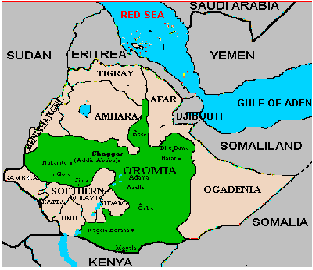
Map of oromia

Map of oromia