In this article, I will accomplish one simple task of showing how political organizations which prefix the words "Ethiopia´´ and "Unity" to their names engage in conspiracy and counter- conspiracy campaigns against others who do not have those prefixes. This is the anti-thesis of their ostensible goals of bringing about unity, democracy and justice in Ethiopia. It is worthwhile to do so because these political organizations are spreading confusion and misinformation to the international community as well as to the nations and nationalities they claim to represent. These confusions and the divisions within Ethiopian political organizations have made it difficult to create a viable and genuine alliance between organizations representing different groups. It has also made it difficult for donors, the international community and continental supporters to rally behind these organizations.
Who are the organizations and how do they suffer from authenticity deficits? Political organizations suffering from chronic authenticity and integrity deficits include the ruling Ethiopian Peoples Revolutionary Front (EPRDF), the defunct Coalition for Unity and Democracy (CUD), the newly formed Andnet Unity for Democracy and Justice Party (UDJP). These organizations deliberately bear the prefixes "Ethiopia" and "Unity", with the intention of creating a misleading impression of how widely they embrace all the nations and nationalities in Ethiopia. Practically, they do not do that. They are divisive and they stand for partisan interests of Tigrayan and Amhara nationalists. For any insider, including the founders and members, it is obvious that these political organizations stand not for all the people in Ethiopia, but for the Abyssinian tribes.
EPRDF conspiracies against oppositionsAt the nucleus of the EPRDF is the TPLF, which controls all branches of government in favor of Tigrayan nationals through its rubber-stamp parliament. The ruling party has conspired against major oppositions and has been able to infiltrate and destroy them. The CUD was destroyed in this way, for example. CUD was a strong Amhara political organization. It portrayed itself as ´the party of all Ethiopian peoples´ in the eyes of the international community before it was infiltrated and damaged. The ruling party forced major oppositions from Afar, Oromia, Somalia, Southern Nations and Nationalities Gambella, Benishangul Gumuz, demanding for freedom and autonomy into exile or into armed liberation fronts. Examples of those forced into armed rebellion include the OLF, ONLF and many others.It is a wide- spread phenomenon that the regime calls peaceful and non-peaceful dissident organizations "anti-people forces, anti –development forces, anti –peace forces and even sometimes ´terrorists´ and narrow nationalists". These defamatory names for organizations genuinely naming themselves after the national groups they represent became justifications for arbitrary violence against the majority of the country´s population (80%), inhabiting seven regional states.
The awareness on the part of the international community seems to be increasing in identifying the EPRDF as political party that represents one group, instead of the whole Ethiopia. However, EPRDF imposts that it standing for Ethiopia´s national interest. Opposition conspiracies against other oppositions When coming to the Amhara-controlled opposition parties such as CUD, UDJP, Ginbot 7 (Gurage-controlled) and so on I cannot deny that they are opposition parties. And there is nothing wrong for Amharas or Guraghes or any nationals to establish and own political parties in their national´s name, but the problem with these parties is they have "unity" and "Ethiopia" prefixes before their names to create an a dangerously misleading impression that they stand for everybody else in Ethiopia. Their compositions do not reflect nationality representations of peoples from the 8 other regional states in Ethiopia. They are really Amhara or Gurage groups and their leaders must learn to face this reality and act accordingly.
The idea of having article 39 in the Federal Ethiopian constitution is totally unacceptable to these parties, who operate under the camouflages of "unity" and "Ethiopia". If they have chances, they will burn down the constitution and redraw the maps of the federal states in Ethiopia. These parties have dangerous ideas of homogenizing the diverse nations and nationals in Ethiopia. Ethnic Amhara´s controlled real political power until 1991, but from 1991 they have been relegated to a position of influential hegemonic power. They still wield influential hegemonic powers in public and private institutions in Ethiopia under the Tigrayan government. But they want to restore themselves to the position of influence they once held for too long if possible by conspiracies, mischiefs and pretention that they represent the whole Ethiopia. This is, of course, a big fantasy given the current high level of political enlightenment in the repressed regional states in Ethiopia. Even the EPRDF knows this and will not let them move a step to real power. We have seen that in the March 2005 General Elections in which Amharas through CUD very strongly challenged Tigre literally. They need to wake up from the dishonesty and illusion they live in and join other forces by genuinely speaking what and who they stand for- the Amhara or Guraghe interest.
There is a huge rivalry and mistrust between opposition parties in Ethiopia. Even if they succeed to destroy the ruling party, afterwards they will be forced to fight each other in the streets before some powerful group takes power by force. This is a totally undemocratic scenario we are used to in many Ethiopian revolutions. This is because of the deep mistrust among political parties, arising from the lack of genuine purposes for democracy and freedom that take into account the diversity and the need to come together by maintaining their differences and particularity. Often, opposition parties are happier about the other party´s destruction, infiltration by government or split in the ranks of oppositions. For instance, many political parties rejoiced when the CUD was infiltrated and destroyed after the 2005 elections, and this year there has been a split in the Oromo Liberation Front (OLF) and the other side is happy about it. And this cycles of hatred between oppositions seem to always repeat themselves. More often than not, Ethiopian oppositions are observed to challenge one another instead of challenging the government. Well, the OLF has also a number of problems that it needs to hammer out in its leadership to continue leading the Oromo people. Introspectively, many authors have written about the problems within the OLF and I will not repeat it here. The political cultures within and between political parties need to improve greatly if genuine freedom and democracy have to happen. Ethiopian political organizations hate each other bitterly and they do not even want to come to a table to discuss in order to reach national consensus at this point when the whole country is at multiple cross-roads. They do not invite one another to a common conference.
They write about one another on websites negatively, and they use other media to campaign against each other. Especially, those hiding under the old "Ethiopianist´ ideology of socially, religiously, linguistically and geographically homogenizing the country campaign against the struggles of Ogadenia, Oromia, Afar, SNNP, Benishangul Gumuz etc just because they identified themselves truly after the their states and nationals/tribes.Amhara political organizations with the prefixes "Ethiopia and Unity" hate to see article 39 of the Ethiopian constitution. Article 39 provides for self-determination of nations and nationalities up to secession. Their motives are to dissolve the regional states and to see Ethiopia in a form of an empire that forces people into homogenization. Tigrayan political parties like the EPRDF and the TPLF are not opposed to article 39 but they do not want its implementation but they use it to amplify divisions and to control the country by force. ERDF/TPLF does not also like the motives of Amhara political organizations because Tigrayans were also oppressed by previous regimes dominated by the Amhara elites. After coming to power in 1991, the Tigrayans forgot that they suffered injustices and oppression and started to oppress other people. The cycle goes on until there is an arrangement to ensure everyone is represented. Consequences of conspiracy and dishonesty. We have already seen the consequences of the politics of dishonesty and conspiracy, leading to a deep mistrust between forces genuinely naming themselves after the peoples they represent and forces abusing the prefixes such as "unity and Ethiopia" only to benefit the groups they come from (<20%). The rest still suffers centrally-imposed injustices.
The second consequence is that these dishonesty and conspiracy makes it impossible for opposition parties to form viable alliances towards freedom and democracy. If there are not strong and genuine alliances, it will be hard to force the EPRDF into political negotiations.
Third, if such dishonesty and conspiracies continue to exist, the international community and donor countries will be confused and misinformed. The confusions and misinformation will definitely lead to donors´ withdrawal of their support for oppositions.
Fourth, the other possible and most severe consequence of such chronic dishonesty, mistrust and conspiracies between political parties and groups is a speedy disintegration of the country itself. With all the serious ideological differences, once that happens, it will be too late reverse.
Qerranssoo Biyyaa
August 29, 2008
Friday, August 29, 2008


Wednesday, August 13, 2008
On the ongoing conflict within the OLF leadership
On regionalism
Maccaa and Tullamaa are two ethnographic branches of Oromo covering the central and western regions. Despite its location at the center, and its adaptation of only these two segments of the Oromo people for its identification, the Maccaa Tullamaa Self Help Association (MTSHA) was established in the 1960s as the first organized pan-Oromo movement representing and reflecting the entire Oromo people’s interest. It emerged as a result of the first wave of Oromo nationalism of the 50s and 60s at the center, with expanding influence throughout Oromia. The location of this first pan-Oromo association is not surprising since it simply benefitted from the relative concentration of the Oromo middle class in the capital city. Despite its ban and subsequent arrest and killing of MTSHA leaders and members, Oromo nationalism continued growing, giving rise to the Oromo Liberation Front (OLF) in the early 70s. The beginning of Oromo nationalism was narrowly geographic and its continued growth appears to have bubbles as a regionally traversed wave covering the last 3-4 decades. The first such wave stood out in the late 1960s and early 1970s in the east. This wave marked the creation of the first guerilla cells in Carcar. It was a very positive and historical development.
Since then, after the banning of MTSHA, there were also bubbles of Oromo nationalism which appeared here and there. The early waves were embraced by the then existing Oromo nationalism which founded MTSHA as well as the rising nationalist sentiments elsewhere. Hence, there was never equal distribution of nationalism that encompassed all regions of Oromia at any given time. This remains to be one of the challenges of the Oromo struggle.
This uneven progress in the nationalist development has at times negatively influenced the underlying political discourse of Oromia. For example, the bubble of the 1980s was costly since it created a split within the OLF. As a result, not only capable leaders were exposed to enemy fire, but internal clashes eliminated many potential leaders, demoralizing the rising pan-Oromo movement. Part of the bubble eventually linked itself to religion with a serious punch to the pan-Oromo movement and to the OLF. Although the problem was diffused to a great extent, thanks to Oromo elders who played key roles, suspicions and detestations remained for a long time. It is proof that the idea of injecting region or religion for political gains can be long-lasting and harmful. Just as the bitter Senator from New York was forced, some say she did it willingly – to accept her defeat in order to keep the unity of the Democratic Party, one has the right to expect from elites to give up their political ambitions to keep the unity of their people.
But it is important to recognize these political bubbles in Oromia as natural and neutral. They are random political platforms and one should not necessarily characterize them as destructive dynamics of the Oromo movement. The uneven rise of nationalism here or there, even with regional characteristics, is not uncommon. Failure to merge these bubbles to mainstream Oromo nationalism and embrace a constructive course of action to promote Oromo interest makes them destructive. They can be made destructive also if they target inward, or backward. They can be extremely divisive if they link themselves to clan and religious politics. Elites have serious responsibilities to guard the overall interest of the Oromo people. There is a lot at stake here.
On clan politics
The historical influence of clan politics on Oromo unity is an interesting topic. The Gada constituents and the election to the Gada offices had to deal with clan sentiments for the overall good of the Oromo people. Oromo modern politics has a serious challenge of merging clan politics with Oromo nationalist identity. This is a gap that can be easily exploited by political enemies as well as group rivalries. The danger is that, enemy manipulations can be easily exposed. That of group rivalries can not. The use of clan politics to promote group politics is a serious offense that could leave a lasting scar on Oromo unity and history. The penalty that comes as a result of clan agitated politics far outweighs the gain one may expect from a reform that comes at the cost of splitting Oromos to clan tentacles. It leads Oromo politics to great shame. It is harmful but acceptable to split for any political motive; it is a shame to split to feed clan lines, a shame unworthy of the Oromo people. I for one prefer no change at all than a change that leaves a clan out or collects only one clan in to a political bunch. Clan politics is a disaster, Somalia par Excellence – the greatest gift to those who wish Oromos ill. It calls for a few days or weeks long retreat from politics so that Oromo elites can all meditate and see the looming danger of their irresponsible actions. Even in politics it is ok to lose sometimes, there is such a thing as winning by losing – losing for a higher cause. It is in this spirit that many Oromos are staying out of this conflict even when they want to voice their version of the truth – to avoid the historic shame. But clan politics is ignorant of the truth; it besmirches the martyrs and belittles the people. How could one be part of clan politics? This psychic itself is sufficiently paralyzing for Oromo struggle. It puts Oromos far below where they thought they are.
On the genesis of the internal clashes of the OLF
Owing to political developments of the last several years, the OLF emerged with three political identities:
On the left, OLF’s ultra-radical members condemn any attempt to negotiate with any Abyssinian organization; leave alone the Tigrean led Ethiopian government. This has been a paralyzing tide for the OLF leadership. In the early 2000s, considerable time and energy was spent needlessly, arguing the merits and demerits of negotiations, interpreting and reinterpreting the very idea of talking to the enemy as violation of the principles of liberation, betrayal of the cause, etc. This leftist tendency may just have been a pretext for power struggle, this I can’t tell. But the leftist arguments readably existed and heavily populated the Oromo internet.
On the right, the OLF is pulled by members who want to drop armed struggle and go into power sharing competition against the TPLF. This matter was a serious agenda both at the 2004 Bergen conference and at the OLF Congress in Eritrea. The group’s motion was defeated by a large majority of the OLF congress. Although the group raises some legitimate concerns and important questions regarding lack of significant progress in the armed struggle, there are no indications that the group has modified its sympathy for the idea of converting the OLF into a legal Ethiopian opposition. I will write more about this below as it relates to the ongoing conflict.
In the middle are the OLF members who are willing to negotiate, but without ever compromising their right to armed struggle.
These three traits of the OLF may be able to walk together, but not run. In fact, failure to segregate these three identities and explain to OLF members and followers is one of the serious neglects of the OLF leadership. In many instances, these internal clashes were deliberately suppressed and the problem tabled, evidently at the cost of tabling progress and victory. Even today most OLF supporters do not understand the source of the conflict; it is only packaged as change. No one is against change that brings success and results. This is not headed that way.
Most of the ultra left dropped out of the OLF some years ago, and have since remained critical of the mainstream OLF without making an outwardly significant impact on the Oromo struggle. The group claims to be the legitimate OLF as now does the rightist group.
The ultra-right emerged openly as a new bubble and a contending force within the OLF in 2004 at the Bergen conference on "Conflict Resolution in the Horn of Africa: A Consultation among Oromo Elders and Leaders with International Scholars". The conference, a consultation as it may be, yielded some new developments which may relate to the current conflict within the OLF.
Apparent from the Bergen discussion was that some members of the OLF openly and clearly argued against the armed struggle accepting Meles’ condition to renounce the armed struggle and become Ethiopia’s legal opposition. This misgiving to the armed struggle was later rearticulated at the OLF congress in Eritrea by the same OLF members who moved the idea in Bergen. The OLF Congress voted the idea down after a heated debate that lasted for several hours. The ongoing conflict within the OLF is led by the same core group which also promoted renouncing armed struggle in order to participate in the Ethiopian elections. In fact, the group’s recent dissociation from the OLF first appeared suspiciously on Ethiopian website, only after hours - obviously a leak by an insider who has vested interest from linkage to the Ethiopian peace politics. Unfortunately it supports the overall motto. Based on events of the last few years, I note that the bubble is predominantly identifiable with the second traits of the OLF. I have not seen sufficient proof to assume that the group has departed from those views expressed at the two major Oromo events. But one must be open to such possibility.
On legal opposition and the OLF’s constitution
I believe legal Oromo opposition within the Ethiopian administration plays a very important role in fighting for the rights of the Oromo people. The Honorable Bulcha Damaksa and the Honorable Marara Gudina are examples of courageous people who cover this dimension of the Oromo struggle. One cannot undermine the wish of those individuals, OLF members or otherwise, who prefer fighting as a legal opposition. However, the OLF raised arms as the ultimate means and backup to the Oromo struggle. The armed option must be central to the very definition of the OLF as the ultimate guard to the only light at the end of the tunnel.
As mentioned above, the ongoing ‘reformists’ have raised some legitimate questions about the lack of sufficient progress in the armed struggle. These are valid issues that should be addressed at the executive or central committee levels, or by the eventual OLF congress. They have ample venues to raise these and all other issues within their organizational responsibilities. Unfortunately, ignoring the bylaws and claiming to take over political power without a due process is more of a coup (successful or not) than a reform. Poor performance that can be corrected democratically does not rise up to a reason worthy of a split. The executive committee can be replaced by a majority vote of the central committee; the central committee can be replaced by the congress. Where is the need for a shortcut and illegal change?
No doubt, the organization must address causes of its poor performance and take appropriate measures to improve its performance. The strength of an organization is rooted on members’ respect and loyalty to its constitution, not to individuals. Otherwise the reason for a split has to be fundamentally ideological – and the only one that comes to mind is the one that calls back Bergen and Eritrea. Why not join Ethiopian forces and wage peaceful opposition politics without burning the bridge? What is the basis or claim under which six OLF executive committee members are ‘fired’ by one executive committee member who claims to take control of the army? How could an OLF army ‘follow’ the one executive committee member who failed to convince the other six elected executive officials? How can one reconcile this with the organization’s constitution to which all officers pledged allegiance? These are unsettling questions; one is comforted by the knowledge that diaspora politics is illusive.
KD
Subscribe to:
Posts (Atom)
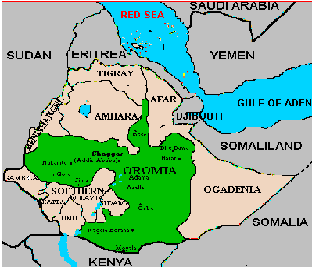
Map of oromia