Addis, Islamic Courts edge closer to open war
By JOHN MBARIA
The East African/Special Correspondent
That Ethiopia and the Somali Islamists are headed for a military conflict was confirmed last week by Ethiopia's president, Meles Zenawi, who declared that his country was "technically at war" with the Union of Islamic Courts (UIC).
Last week, media reports detailed Zenawi's vow to "crush" the UIC. However, while UIC might not be a match for Ethiopia, the reality on the ground will demonstrate that an all-out war with the Islamists will place Zenawi's regime in a perilous position.
Ethiopia's confidence arises from its perceived military advantage over the Islamists. According to Jane's Defence Weekly, the Ethiopian National Defence Army is estimated to have between 120,000 and 150,000 troops. It is the best equipped military machine in the Horn of Africa, boasting of massive stocks of military hardware that includes old but still serviceable Soviet made T-55 battle tanks, heavy artillery, multiple rocket launchers and towed howitzers.
And though the country's military spending has dropped from close to $1 billion a year during Mengistu Haile Mariam's reign to slightly over $405 million today, it still outstrips its neighbours. As an ardent backer of the United States' counter-terrorism strategy in the region, Ethiopia has been getting substantial US assistance in terms of training, logistics, transport and direct sales of military hardware.
With such preparedness, US counter-terrorist strategists believe the Ethiopian forces might be just what the region needs to check the ambitions of the radical elements within UIC.
Unfortunately, other factors might come into play to destabilise Ethiopia's campaign against the UIC. For one, an Ethiopian war against the Somali Islamists would involve many interested players. Already, there is a growing perception among Muslim countries interested in the conflict that Ethiopia, half of whose population of 77 million are Christians, is leading a US-backed Christian assault against a Muslim country. Muslim countries such as Libya, Egypt, Iran, Yemen, Djibouti and to some extent Saudi Arabia have shown more than a casual interest in supporting the Somali jihadists, if reports emanating from US experts on the region are to be believed.
Zenawi has ruled out firing the first shot. Addressing the press last week, the president talked of his country's restraint, saying the Islamists "will have to force us to fight." But even as he said this, reports showed that hundreds of Ethiopian troops were in Somalia digging trenches at Daynunay, the Transitional Federal Government's military camp outside Baidoa.
This seemed to have encouraged Ethiopia's arch-enemy, Eritrea, which has reportedly opened a new anti-Ethiopian front by supplying the jihadists with arms. Further evidence that Eritrea is spoiling for war with Ethiopia came when the latter moved 1,500 troops into a UN demilitarised zone close to its border with Ethiopia. Seemingly, a war with the Islamists might just be what Eritrea is waiting for and – going by the outcome of the 1998-2000 conflict, which did not have a decisive winner – there is no guarantee that Ethiopia will be victorious this time round.
A war with Somali Islamists could also open new internal battle fronts in Ethiopia. Last week, the leader of the Islamic radicals in Somalia, Sheikh Hassan Dahir Aweys, urged Ethiopians to revolt against Zenawi's regime. The country's significant Muslim population might not necessarily heed the call, but give encouragement to groups long engaged in an internal war with successive Ethiopian governments.
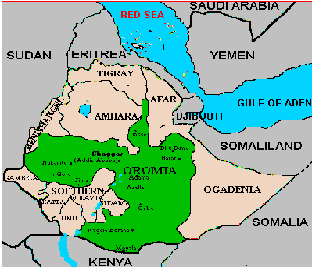
One such group is the Oromo people, whose population – standing at 30 million – constitute half of the country's population. Colonised in 1887 by Menelik, an Abyssinian king, the Oromo have never given up the struggle to liberate their territory, Oromiya. According to Jane's Defence Weekly, their biggest military wing, the Oromo Liberation Front (OLF), is the most robust armed insurgency in Ethiopia. Although it has remained relatively ineffective and has never posed a serious threat to the Ethiopian government, OLF has sustained a low-level guerilla campaign against Ethiopian security forces since it was formed.
Zenawi needs to appreciate the danger posed by real and potential fundamentalists inside Ethiopia. For instance, Jane's Defence Weekly says, another armed group, the Ogaden National Liberation Front (ONLF), not only remains dedicated to self-determination of the Ogaden region – an arid area that is home to four million Ethiopian Somalis – but has also ganged up with radical Islamists in the past. The weekly says that over the years, ONLF has established links with the Al-Ittihad al-Islami, one of the Somali Islamist groups reportedly active in Puntland, which has been accused by the US of being a terrorist organisation.
Many other opposition groups in the country – especially from Afar, Oromiya and Ogaden – operate either as armed militias or as affiliates of armed groups.
Besides the OLF and ONLF, other groups are Afar Revolutionary Democratic Unity Front, Benshangul Liberation Movement, Ogaden National Liberation Front, Sidama Liberation Front, Tigrayan Alliance for National Democracy and the United Oromo Liberation Front.
Analysts say the fact that all these groups have decided to take up arms against Zenawi's regime is testimony to the regime's oppressive style of governance.
Zenawi's regime might have overlooked these scenarios as it seeks to protect President Abdulahi Yusuf's weak government while engaging in a US-proxy war against alleged terrorists within the UIC.
Monday, October 30, 2006


Saturday, October 28, 2006
Secretary general of Parliament on the run
Indian Ocean Newsletter N° 1200
According to several tallying information sources, the secretary general of the Ethiopian Chamber of Representatives, Foto Bedane, took advantage of an official journey to Europe to defect from the regime of Prime Minister Meles Zenawi. He was part of an Ethiopian parliamentary delegation headed by the Speaker of the House of Representatives Degfe Bula which had left Addis Ababa on 13 October to go to Geneva (Switzerland) to attend the 115th general assembly of the Inter-Parliamentary Union (IPU) from 16 to 18 October. Foto Bedane is reported to have then decided not to return to Addis Ababa and may seek refugee status in the United States. His predecessor, Samuel Alemayhu, had similarly defected after a world conference of speakers of parliament in September 2005 in New York.
According to several tallying information sources, the secretary general of the Ethiopian Chamber of Representatives, Foto Bedane, took advantage of an official journey to Europe to defect from the regime of Prime Minister Meles Zenawi. He was part of an Ethiopian parliamentary delegation headed by the Speaker of the House of Representatives Degfe Bula which had left Addis Ababa on 13 October to go to Geneva (Switzerland) to attend the 115th general assembly of the Inter-Parliamentary Union (IPU) from 16 to 18 October. Foto Bedane is reported to have then decided not to return to Addis Ababa and may seek refugee status in the United States. His predecessor, Samuel Alemayhu, had similarly defected after a world conference of speakers of parliament in September 2005 in New York.
Subscribe to:
Posts (Atom)
Map of oromia